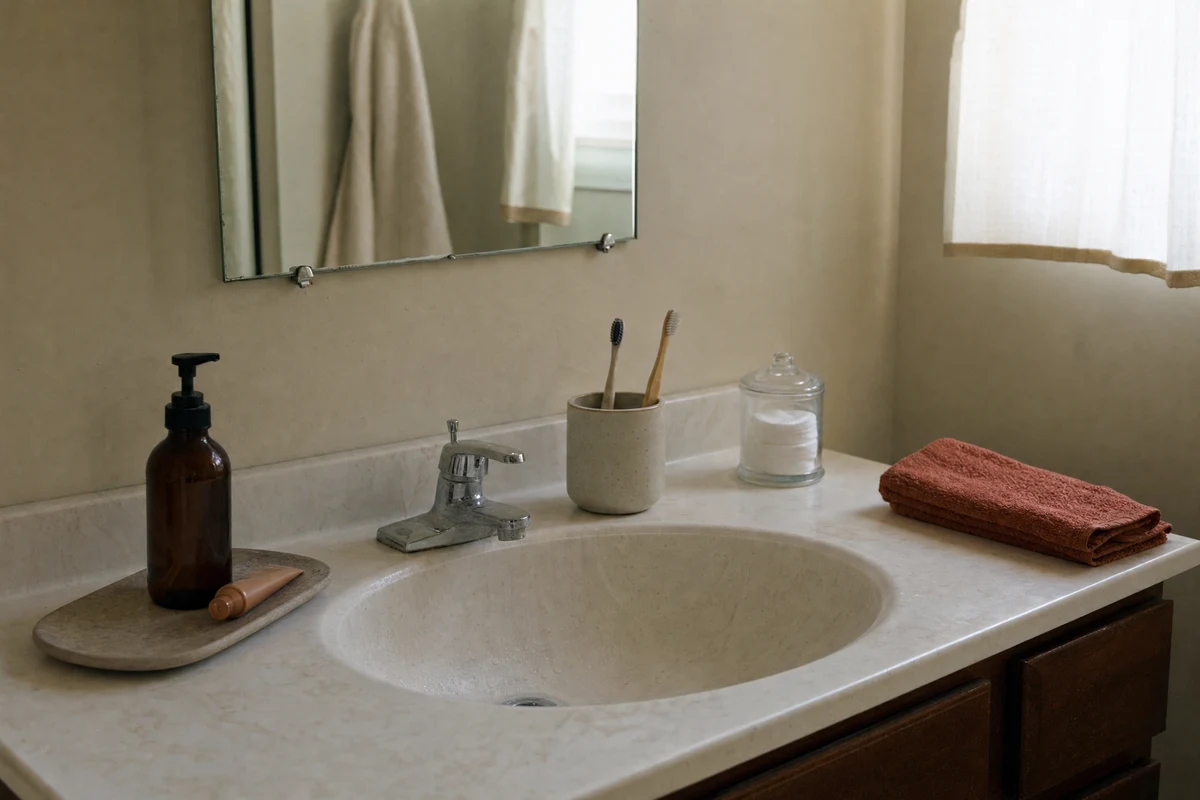
Put your daily bathroom items on a towel and separate the ones you can store elsewhere. Then measure the space they need. Buying a tray first can leave you trying to fit your routine into it.
The goal here is a counter you can use and wipe down. You can keep the original bottles; matching containers are optional.
Record a routine, not an ideal item count
Write down what you use during a normal morning and evening. Give each item a proposed home. A toothbrush needs a different arrangement from a backup shampoo bottle, even though both are bathroom supplies.
Try this worksheet before buying anything:
| Item | When you use it | Proposed home | Check before it stays there |
|---|---|---|---|
| Toothbrush | Morning and evening | Upright open holder | Can it air dry? |
| Face wash | At the sink | Counter or nearby shelf | Can you pick it up and return it easily? |
| Spare shampoo | When the current bottle runs out | Suitable cupboard | Can you see and reach it? |
| Hairbrush | During hair care | Drawer or open container | Does the handle remain accessible? |
| Medicine | As directed | Location required by its label | Confirm storage with the pharmacist if unsure |
Adapt the worksheet to the products you actually use.
For a shared bathroom, try a separate small container for each person’s dry accessories. Keep the hand soap accessible to everyone. If two trays crowd the sink, use separate drawers or shelves instead.
Reserve room for hands and bottles
Measure the usable counter after allowing for the basin, faucet and anything fixed in place. Open the medicine-cabinet door and nearby drawers too; the organizer must not obstruct them.
For a hypothetical example, suppose you have a clear rectangle 18 inches wide and 10 inches deep beside the sink. Place a tray with an outside footprint of 12 by 6 inches in one corner, with its 12-inch side along the 18-inch edge. That leaves a 6-inch strip beside it and a 4-inch strip behind it. Use the paper test below to check whether that space gives your hands enough room.
Cut paper to the tray’s outside size and lay it in the proposed spot to check counter clearance. For bottle fit, get the usable inside dimensions from the maker or measure the tray in person, then mark that smaller space within the outline. Arrange the actual bottles inside it, including their widest parts. Try operating the pump and lifting and returning each item using your usual reach and grip.
Keep toothbrushes open to the air
The American Dental Association recommends rinsing a toothbrush after use, storing it upright and letting it air dry. Routinely enclosing a moist brush encourages microbial growth compared with open storage. The ADA also advises replacing a brush every three to four months, or sooner if the bristles are worn.
Choose a holder you can clean according to its maker’s instructions. Check whether it is dishwasher-safe before putting it in the dishwasher. Keep brush heads from resting against another brush or the surrounding bottles.
Don’t buy a covered jar just to make the counter match. Start with a suitable open holder and see whether you need another container at all.
Move medicines out of the decorating plan
A cabinet called a medicine cabinet is not automatically a suitable place for medicines. MedlinePlus warns that bathroom heat and moisture can damage them. It advises keeping medicines in their original containers and asking a pharmacist about specific storage instructions.
Follow the medicine’s label, including any temperature requirements. Keep medicines out of children’s sight and reach in a secured location. Don’t transfer them into an attractive unlabeled jar or assume that a cool-looking corner of the bathroom meets their storage needs.
Use the bathroom cabinet for other suitable small items if it helps your layout.
Keep packaging until you have a refill plan
For this setup, keep skincare and cleaning products in their original packaging. Put the bottles together on a washable tray if you want a more orderly arrangement. That avoids making decanting another task before the counter works.
If you later choose a refillable dispenser, use products intended for that dispenser and follow both makers’ cleaning and refill instructions. Save the product identification and use directions. Do not assume that every lotion, soap or treatment is suitable for transfer just because it pours.
Match cleaning products to the surface
Identify the counter material before using a stain remover. The Natural Stone Institute recommends neutral cleaners or mild dishwashing detergent for natural stone and advises against acidic cleaners. Vinegar and other acids can dull or etch calcareous stone, including marble. Abrasive products can also scratch surfaces.
A hidden-spot test does not make an unsuitable acid appropriate for marble. Use the care instructions for your actual counter, sink and faucet finish. They may require different products.
For routine maintenance, move the tray and wipe up splashes as the surface instructions allow. Choose a container with a base you can inspect and dry; avoid leaving a wet tray sitting unnoticed on the counter.
Measure below the sink before buying shelves
Record the clear width on each side of the plumbing and the available height. Include the door opening, hinges and the path a pull-out bin would travel. Leave access to shutoff valves and plumbing connections.
Make another paper footprint for a proposed organizer. If the cabinet is too crowded, try one shallow bin first. A second shelf is useful only if you can still retrieve the things underneath it.
For a pedestal sink, consider a portable caddy stored in a suitable nearby cupboard. Any added wall cabinet or furniture must be installed and secured according to its instructions.
Leave the paper tray outline in place for a normal morning before ordering. If bottles keep moving outside the outline, adjust the layout before buying an organizer.
Correction: An earlier version recommended bathroom storage for medicines and suggested vinegar or a general-purpose abrasive cleaner too broadly. The storage and surface-care advice above replaces those recommendations.