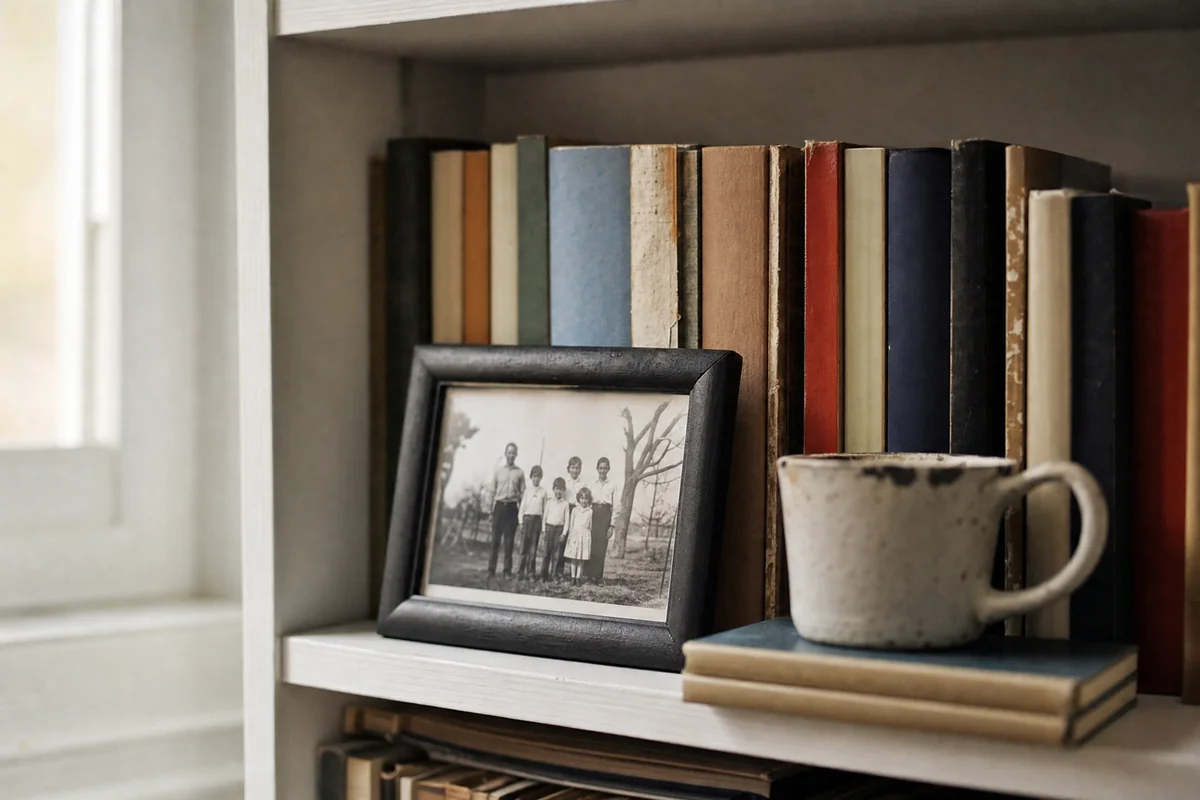
Start with the books you reach for and a frame you already own. Put those on one shelf before buying anything for the rest of the bookcase. A postcard in a mismatched frame gives you something more specific to work with than a cart of matching decorative objects.
The Cambridge Dictionary new-words blog describes bookshelf wealth as a style built around books and objects their owners love. That leaves room for dog-eared paperbacks, children’s books and the odd manual you need often. You don’t need antique bindings or a room-sized library.
Check the bookcase before loading it
Find the assembly instructions and the load limit for each shelf. A row of hardcovers counts toward that limit along with anything sitting on top. Don’t fill a shelf whose supports are missing or whose board is damaged.
CPSC’s Anchor It campaign advises anchoring furniture with shelves to the wall to prevent tip-overs. Follow the furniture and anchor manufacturers’ instructions, using fasteners suitable for your wall. Keeping the heavy books low doesn’t replace an anchor.
That applies in a rental too. Get permission for the required installation before buying a bookcase. If anchoring can’t be arranged, postpone the new shelving and work with furniture that’s already safely installed. A smaller footprint or a shorter bookcase isn’t an automatic exemption from the manufacturer’s instructions.
Give each shelf a job
Start with these placement priorities.
| What you have | Try this position | Leave room for |
|---|---|---|
| Current reading | The shelf easiest to reach from your chair | Taking out a book without moving decor |
| Larger books | A lower shelf, within its load limit | The full depth of the books |
| One small framed picture | A shelf you see easily when seated | The frame’s own stand |
| Remaining books | Grouped by subject or author | Finding and replacing each title |
Keep the frame’s base fully on the shelf. Try a frame with its own stand beside the books, then take out a book to see whether the position works. Leave the front edge clear where hands pass.
If you have twenty books, try twelve standing together on one shelf. Put the other eight on the next shelf: five upright and three lying flat beside them. Choose the three you use least for the stack, so reaching a favorite doesn’t mean dismantling it.
Set your small frame beside the upper group with its stand open. Leave a visible gap between the frame and the books. Put an existing bowl on the lower shelf, on the opposite side from the frame. Sit down and look at the two shelves together. If the objects crowd the books, take away the bowl before moving everything closer together.
That is one trial arrangement, not a required ratio. Swap which side holds the frame if it disappears behind your chair from the doorway. Let the spines keep their mixed colors; repeat one color from the frame or bowl elsewhere only if you already own something suitable.
With more shelves than books, leave an opening empty. There’s no need to buy filler for every one. For a more spaced-out arrangement, use the bookshelf styling guide as a separate visual direction.
An all-books shelf can stay all books. The useful question is whether you enjoy looking at it and can still use it.
Choose lighting for the room you have
Try the existing light before shopping. Sit where you read with a book open. If you need more light there, start with a lamp beside the chair; an attractive glow across the shelves may not light the page where you’re sitting.
A lamp inside a bookcase needs the clearances specified by its manufacturer. If it won’t fit with books kept away from the shade and bulb, use a suitable adjacent table. Before buying a bulb, check your lamp’s required base, wattage limit and dimming compatibility. If it requires dimmable bulbs, use those.
Keep the cord away from furniture pinch points and walking routes. Keep any extension cord uncovered; ESFI warns that covering it can trap heat and create a fire hazard.
Set a spending limit after the rearrangement
Write down what’s still missing. Price the exact item and its required accessories together: a lamp plus its compatible bulb, or a bookcase plus the specified anchoring hardware and installation.
Here’s a sample budget allocation, not a set of retailer prices. If you choose a $40 limit and reserve $10 for a frame, $30 remains for lighting. If the compatible lamp-and-bulb combination costs more than that allowance, keep the current light and wait. Don’t save money by omitting a required part.
The no-purchase version is books and frames you already own on safely installed furniture. New shelving is a separate project; include delivery and installation before deciding that a low sticker price fits your budget.
Skip decorative book sets bought just to fill a measured gap. Keep that space for the next book you want to read.
Make it easy to keep using
Leave the most-used books unobstructed. Put a picture in front of the reference book you rarely open, not the cookbook you pull out every evening. When you return a book, check that the frame still stands firmly and nothing has crept over the shelf edge.
Remove the frame for a day. If books are easier to reach without it, move the frame elsewhere and leave that space clear.