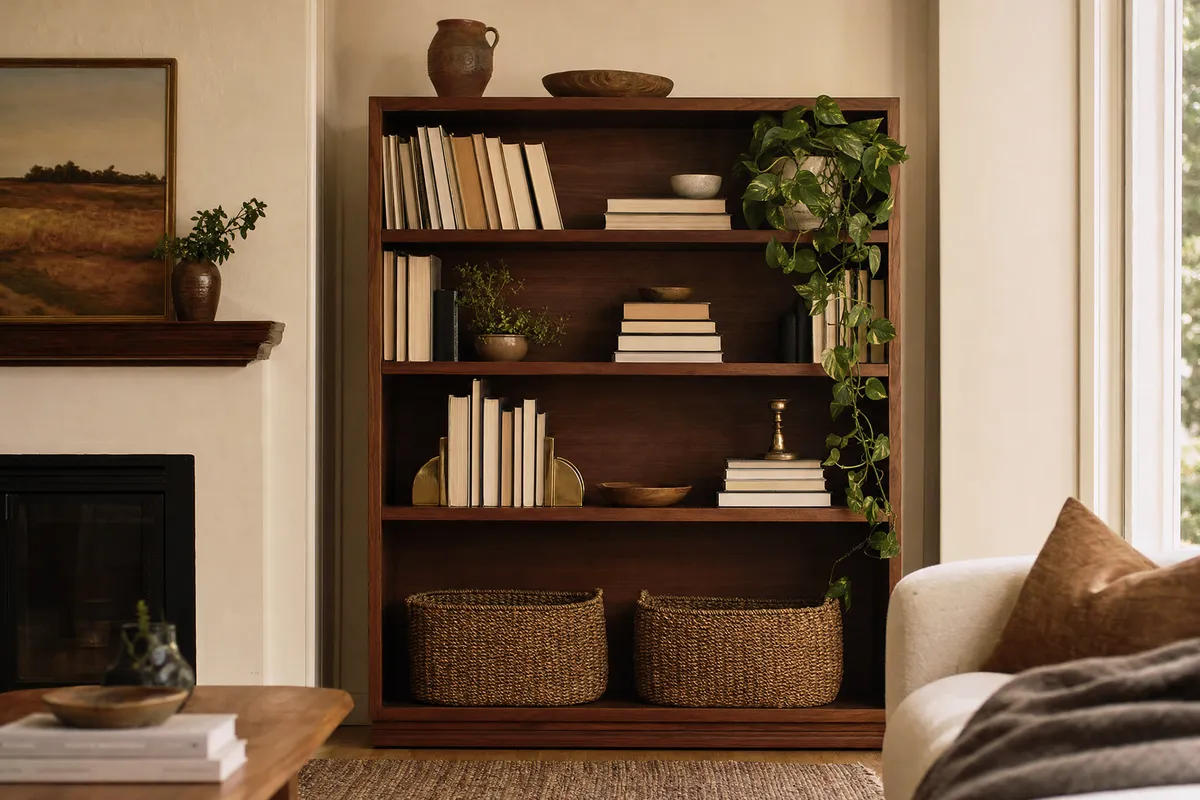
Designer bookshelves follow rules specific enough to copy, and the designers have published them. This guide assembles the actual numbers (Bobby Berk’s, mostly, since he’s the one who commits to ratios) into an order you can execute on a Saturday with the books you own and maybe $30 of thrifted filler.
The numbers designers actually use
From Bobby Berk’s own styling guide: roughly two-thirds books to one-third objects, about 70/30 vertical-to-horizontal book orientation, and five to seven decorative pieces per full bookcase rather than a crowd of little things. Each shelf gets a high point, a mid point, and a low point.
Emily Henderson’s rules fill in the composition side (she wrote a whole book on it, Styled): consistent color palette, mixed shapes and scales, repeated groupings rather than even scatter, and her filter for what earns a spot at all: every object should be functional, sentimental, or beautiful.
And Nate Berkus contributes the two moves that fix most amateur shelves: treat each shelf as its own small scene while watching the whole unit, and let some shelves skip books entirely so the eye gets a rest. His triangle method (arrange heights so the tops of objects form loose triangles within and across shelves) is the cheapest trick here, because it costs nothing and registers from across the room.
The assembly order
Empty everything. Studio McGee’s method starts from a blank slate, and they’re right: styling around what’s already there just rearranges the problem. Dust while you’re at it.
Books first, both directions. Place your vertical runs and horizontal stacks before any objects, aiming near Berk’s 70/30. Horizontal stacks do double duty as pedestals: a small object on a three-book stack is the basic unit of shelf styling. Scatter your spine colors rather than rainbow-blocking them; Henderson’s palette rule is about the objects and shelves looking calm, not about alphabetizing books by color.
Objects into the gaps, biggest first. Place the vase, the bowl, and the lantern before any small object gets a say. Remember the ceiling: five to seven decorative pieces total on a normal bookcase. It will feel sparse at first; Henderson has a whole post on the failure mode of too many small random objects.
One living thing. A trailing pothos on an upper shelf, or decent faux eucalyptus in a vase; every designer on this list includes some green.
Baskets on the floor-level shelf. The bottom shelf is where the visual weight and the actual clutter both belong: $8 to $25 at IKEA (the FLÅDIS seagrass basket is $18), Target, or HomeGoods. Two matching baskets hide the board games and cables that were ruining the composition.
Step back at arm’s length, then from across the room. McGee’s method again. Squint. Wherever your eye snags on a cluttered clump or a dead zone, that’s the edit.
The budget moves that look expensive
Thrifted hardcovers are the cheapest styling material you can buy: $1.39 at many Goodwill locations, up to $4 in pricier regions. Ten hardcovers for under $20 fills the gaps a sparse collection leaves. Pull the dust jackets off; Berk recommends it because the cloth bindings underneath look uniform and calm in a way the jackets never do. (Keep jackets on anything collectible; collectors price them as most of a rare book’s value.)
Vintage brass bookends turn up at thrift stores for a few dollars if you’re patient, or $15 to $40 for a pair on eBay and Etsy if you’re not. New budget pairs run $13 to $19 on Amazon.
And if you want the full designer-library look without owning the books: decorator services literally sell books by the foot (booksbythefoot.com starts at $12.99 per linear foot, ten to twelve books). I can’t quite endorse buying books as lumber, but it’s useful to know the pros’ floor price when you’re deciding whether your own shelves are under-booked.
What to skip
Rainbow spine arrangement (dated, and it makes every book harder to find), matching decorative box sets sold as “shelf decor bundles,” anything under 4 inches tall that isn’t part of a group, and the urge to fill every shelf edge to edge. Empty space is doing compositional work; Berk calls it visual rest, and removing one object per shelf is the single most common fix when a finished shelf still looks off.
Bookshelf styling FAQ
What if I have way more books than the ratio allows? Then you have a library, not a display shelf, and that’s a fine thing to be. Style the two or three most visible shelves by the rules and let the rest be honest storage. Room for Tuesday’s shelf-styling guide for heavy book collections recommends grouping paperbacks together on lower shelves, where their busier spines become texture.
Do the rules change for a small single shelf or floating shelf? Same principles, smaller cast: one horizontal stack, one object on it, one taller thing beside it. The triangle method matters most when there’s only one composition to get right.
How do I stop styled shelves from collecting clutter? Re-run Henderson’s filter every quarter: functional, sentimental, or beautiful. Anything that snuck on without qualifying goes in the basket on the bottom shelf.
Is it worth buying books I’ll never read? Ten thrifted dollars’ worth to fix proportions, sure. Beyond that, the shelf stops looking like anyone in particular lives there, and the fall version of this problem has a cheaper fix anyway: swap in seasonal objects, not seasonal books (the neutral fall pieces work year-round).