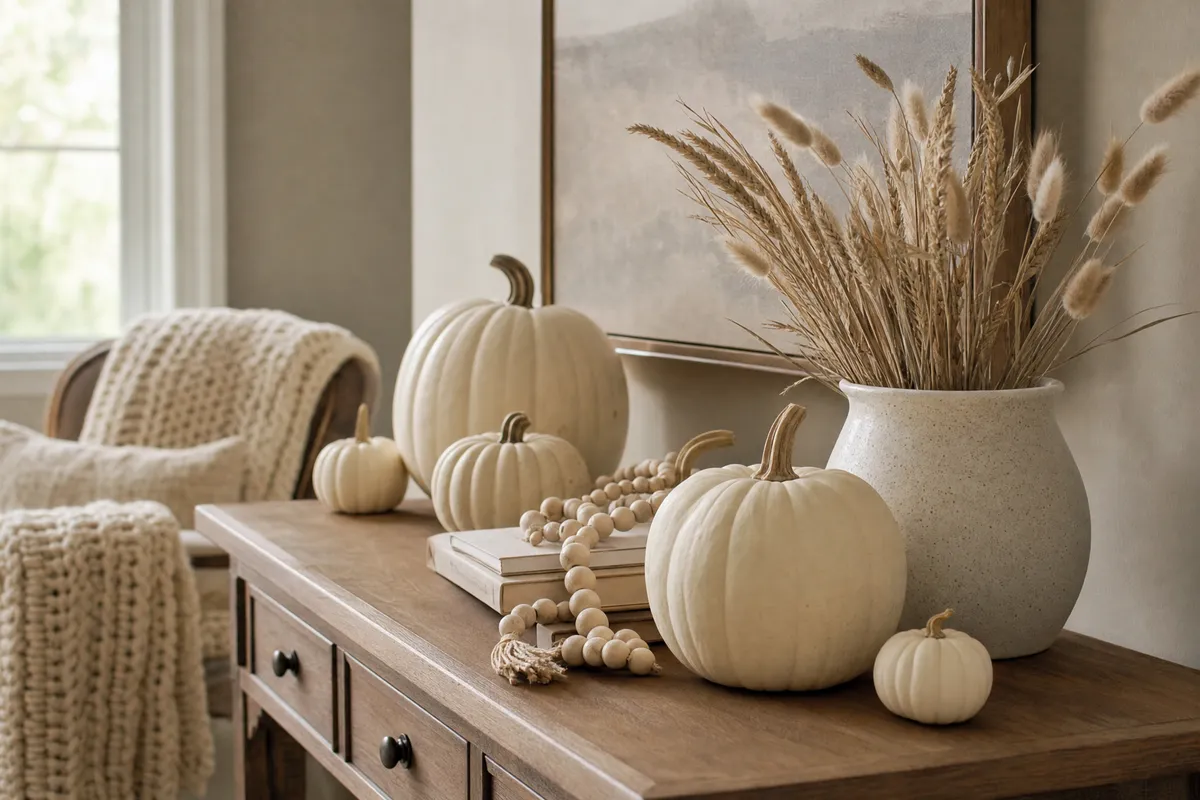
Fall decor has no orange requirement. Cream pumpkins, wheat stems, warm browns, and heavy texture read as autumn just as loudly, and they blend into homes that aren’t decorated around a holiday aisle. The look runs on three ingredient groups: white pumpkins, dried botanicals, and brown-family textiles. Prices for all three below.
This isn’t a fringe preference anymore, either. Pinterest’s trend reporting named warm minimalism among its interior directions for 2025, and Pantone’s color of the year that season was Mocha Mousse, a warm brown pitched explicitly at comfort. The seasonal aisle finally caught up to people who never wanted a pumpkin the color of a traffic cone.
The palette, named
Work inside this range and everything coordinates without effort: cream and ivory at the light end, then oat, taupe, camel, rust if you want one warm note, and chocolate brown at the dark end. Green stays muted (sage, olive). Before buying anything, ask whether it would look wrong in your house in February. If the answer is no, buy it, because you’ll never have to box it up in a labeled bin.
White pumpkins: the real ones
Real white pumpkins are grown varieties, not spray paint. The names worth knowing at a farm stand: Lumina and Casper (classic mid-size whites), Baby Boo (the true-white minis), and Cotton Candy, which growers say holds its white best when kept out of direct sun. Worth remembering for a sunny porch.
White heirlooms run a couple of dollars more than orange. Trader Joe’s is the cleanest example, with heirloom pumpkins at $7.99 against $4.99 for standard orange in the 2025 season, minis from about 89 cents. Farm stands land anywhere from $2 to $8 by size. They show up in September, and since the white varieties get planted in smaller volumes than orange, early September shopping gets the pick.
Real whites also yellow slightly as they age. If a photo-perfect white matters more to you than the real thing, that’s what the faux section is for.
Faux pumpkins worth their price
Target owns this category on a budget. Threshold’s woven two-tone pumpkins start around $5, the ceramic ones run about $10, and the Hearth & Hand fall line has opened as low as $2.99. These lines drop early (Target’s fall collections have been landing online in June and July), sell through by late September, and the good neutrals go first.
Velvet and fabric pumpkins in cream and taupe are the other safe buy. Skip anything glitter-flocked.
Dried botanicals: where the texture comes from
A vase of dried stems does what a mum does for the orange palette. The hierarchy, cheap to fancy: wheat bundles (Hobby Lobby stocks them, typically under $10, and its floral wall rotates 40% off), bunny tail grass (budget mixed sets on Amazon commonly run $10 to $20 for a big bunch), and pampas grass (large natural bundles more like $20 to $40).
One warning about pampas: the cheap natural stuff sheds. Fluff on the console, fluff on the floor, fluff in the dog. Sellers now advertise “no shedding” as a feature, which tells you what the reviews of everything else say. A light coat of hairspray on a shedding bundle helps, or buy bunny tails instead.
Foraging is the $0 tier: dried grasses, seed heads, and bare branches from your own yard are the same texture the craft store is selling you.
Textiles: brown is the new orange
This is where the palette earns the “cozy” that orange decor claims by default. A cream cable-knit or waffle throw ($15 to $25 at Target and Walmart, per the living room guide), boucle pillow covers in oat and taupe ($12 to $25 for a 2-pack on Amazon), and a muslin gauze throw if you like the layered-linen look ($25 to $40).
Texture carries the seasonal signal that color would otherwise carry, so go coarser than you normally would: chunky knits, boucle, raw linen, rough ceramics. Smooth, shiny surfaces say summer no matter what color they are.
The finishing layer
Wood bead garland draped over a stack of books or along a mantel: $10 to $20 pre-made, or about $3.50 in craft-store beads and twine if you’d rather make your own. Unscented ivory candles, brass if you have it, and one rust accent maximum if the room needs a temperature bump. Then stop. The neutral fall look dies by the eleventh cream pumpkin.
Neutral fall FAQ
Does neutral fall just mean beige everything? No. It means the color comes from materials (wood, wheat, clay, linen) instead of dye. A room of flat beige objects is boring; a room of cream, walnut, and dried grass is warm.
Real or faux white pumpkins? Real outdoors and for September–October (cheaper, better looking, compostable). Faux for the mantel pieces you want identical next year.
Can I mix in some orange? One rust-toned thing per room works beautifully. The palette breaks at bright orange, not at rust.
What’s the cheapest way into the look? A $10 wheat bundle in a vase you own, plus whatever brown textiles are already in the house. Half of this look is deciding not to buy things.