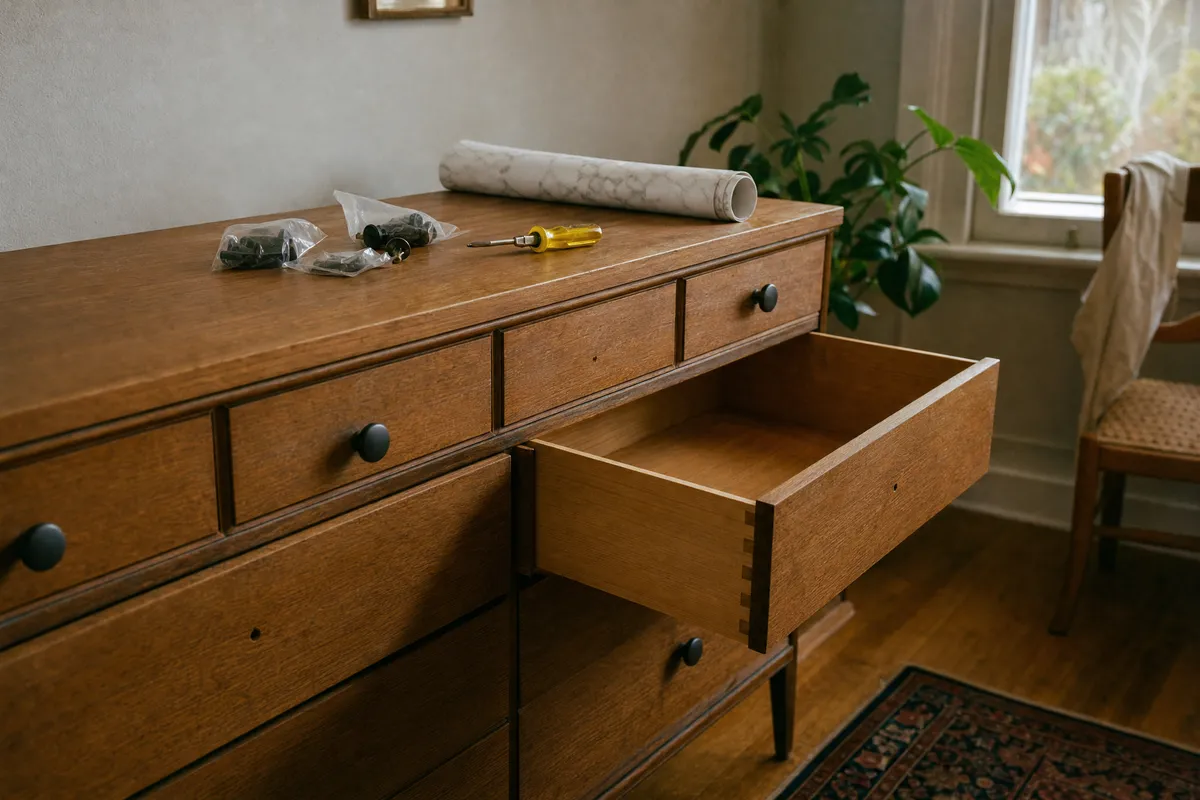
Nobody checks the brand of a dresser. People notice the knobs, the top surface, and whether the drawer sounds hollow when it shuts, so the strategy is to upgrade what gets perceived, in order, and stop when the piece passes. IKEA hacking is a full-blown industry at this point (The Hustle counted 64 million TikTok views on #ikeahacks and found 43% of surveyed readers had modified IKEA furniture), but most of the movement’s value is concentrated in a few cheap moves.
Seven verified under-$20 upgrades, ordered by how fast a guest notices them.
1. Swap the hardware ($15 to $19)
A 10-pack of solid matte-black or brass knobs runs $15 to $19 on Amazon (Ravinte’s 10-packs are the standard recommendation), and swapping them takes a screwdriver and ten minutes. For contrast, single knobs at Anthropologie start around $14 apiece, which is what the look costs at retail. Two of those on a thrifted dresser’s top drawers, plus the cheap 10-pack everywhere else, is an old designer trick that works.
Start here if a piece only gets one upgrade. The knobs also get touched every single day, which no other item on this list can claim.
2. Marble the top ($13 to $14)
The top surface is the second thing eyes land on and the first thing water rings ruin. A roll of marble contact paper is $13 to $14 at Walmart (about 13 square feet, enough for a dresser top and a nightstand), and modern versions are thick enough to survive scrutiny at conversation distance. Corners take most of the care: heat them slightly with a hair dryer and wrap like a gift.
It’s also the most reversible move here, which makes it the safest one for renters and the commitment-averse.
3. Fix the edges ($10 to $15)
Chipped particleboard edges are what scream cheap from across a room, and the fix is weirdly satisfying: iron-on edge banding, $10 to $15 for a 50-foot roll at hardware stores. Iron it over the damaged edge, trim with a utility knife, done. Fifty feet does every sad edge in an apartment with most of the roll left over.
4. Marker the scratches ($8)
A Minwax stain marker in roughly your wood tone is $8 and covers years of scratches on any wood-finish piece in minutes. It doesn’t repair anything, and from viewing distance it doesn’t need to.
5. Silence it ($16 for ten)
Expensive furniture is quiet. A 10-pack of soft-close damper adapters runs about $16 and retrofits onto cabinet doors so they shush closed instead of clacking. It never shows up in photos; people notice it in person without knowing why.
6. Felt the feet ($14 to $17)
Nail-on felt glides, $14 to $17 for a 40-pack. Chairs stop scraping and the dresser stops knocking the wall. Cheap furniture gives itself away by sound as much as by materials, and items five and six fix the whole soundtrack for about $30.
7. Cane a cabinet door (about $19 for a door’s worth)
The trendiest one and the only real craft project on the list: pre-woven cane webbing runs about 80 cents an inch of length from caning suppliers (HH Perkins), so a cabinet-door insert’s worth lands near $19. Replace a boring door panel or glass insert with it and a $60 cabinet borrows the silhouette of the $600 rattan pieces everywhere right now. Full rolls run $38 and up, so buy the cut size for a first project.
The two upgrades worth breaking the $20 rule for
Honesty about the famous ones: new legs cost more than $20 now. A set of four 16-inch hairpin legs runs $30 to $45 (short 8-inch tapered wood sofa legs squeak in around $21 to $25), and no single move changes a low IKEA piece more, even over budget. And chalk paint’s standard 30-ounce can is $21 to $27 these days; a full furniture repaint is a weekend and about $35 with supplies, which is a bigger commitment than this list is about.
Prettypegs, the Swedish company that built a whole business on IKEA leg swaps, is charging $12 to $48 per leg, and their founder’s pitch to The Hustle explains the entire economics of this list: people pairing DIY with high-end design details to break out of mass-produced sameness. You’re doing the same thing with a screwdriver and $20.
What doesn’t work
Painting laminate without primer (it peels within the month), stick-on “gold” hardware covers, fake drawer-front molding kits on curved surfaces, and any upgrade to a piece that’s structurally shot; wobbly frames and busted slides turn cosmetic money into wasted money. Fix function first or donate it.
Cheap furniture FAQ
Which single upgrade has the best effort-to-effect ratio? Hardware. Ten minutes, under $20, and it’s the detail everyone touches and sees daily.
Does contact paper survive real use? On vertical surfaces and dresser tops, years. Under potted plants or hot mugs, no; it’s vinyl. A tray solves both.
Will new knobs fit my existing holes? Single-hole knobs, almost always. Pulls with two screws need the same center-to-center spacing as the old ones; measure before ordering, it’s printed in every listing.
Is any of this worth doing on genuinely bad furniture? The $8 marker and felt pads, sure. Beyond that, put the $50 toward the next thrift-store solid-wood find instead; upgrades compound on good bones and evaporate on bad ones.