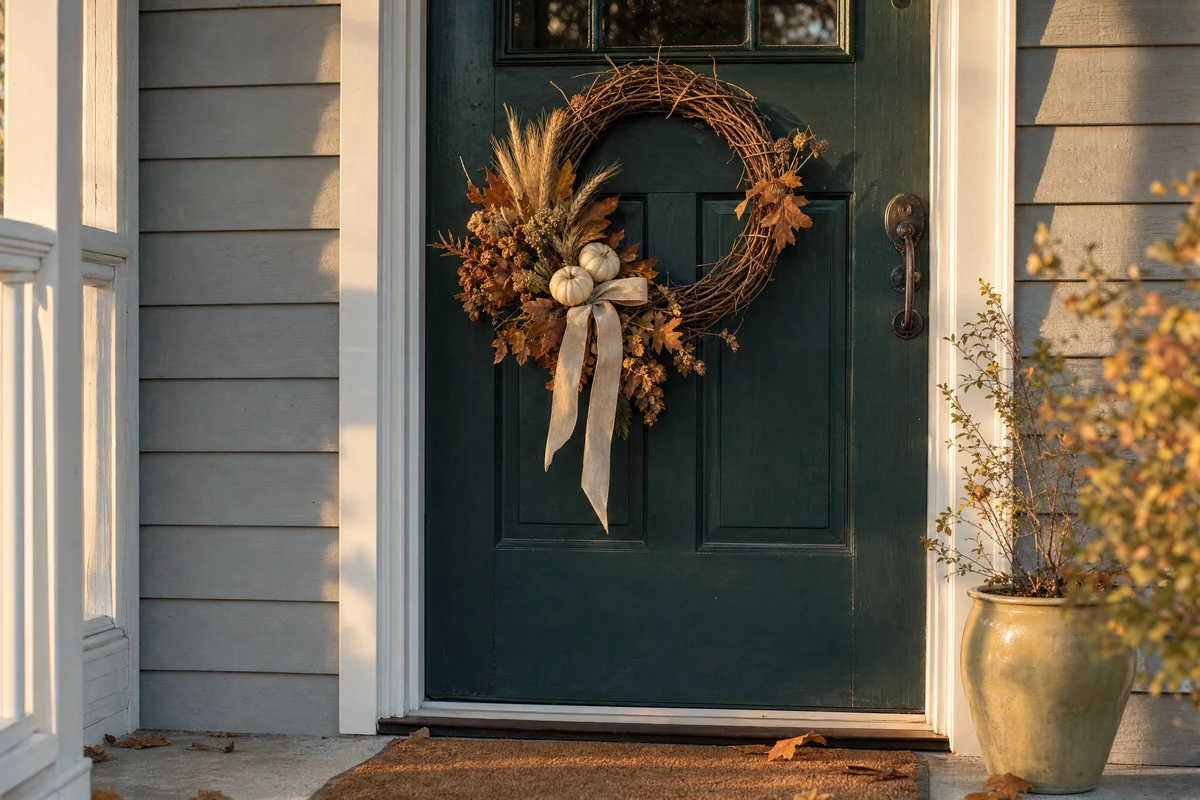
A dollar store fall wreath can start with a form you already own and a few bunches of foliage. Before buying a basketful, lay out one small section. The number of usable sprigs in a bunch matters more to your shopping list than the number of bunches in somebody else’s tutorial.
This is a planning guide, with calculated examples rather than a tested shopping kit. The wreath image is an AI-generated illustration, not a photograph of a finished project.
Choose a full circle or a partial wreath
For a full wreath, plan foliage around the whole form. For a partial wreath, leave some grapevine exposed and concentrate the leaves on one side. Either can be the finished design; exposed vine does not have to mean you ran out of stems.
Start with two foliage colors and one accent if you want an easy palette to shop for. Cream pumpkins with brown leaves are one option. For a porch without orange, use the combinations in the neutral fall decorating guide.
Choose foliage whose existing finish you like. This version needs no spray coating. A can of clear finish adds another purchase, and its suitability depends on the exact coating and material. It is not a requirement for making a wreath.
Check the finished size against your door
Cut a paper circle in your proposed finished diameter and hold it against the door. Check the handle and peephole, then the space between the door and any storm door. The hanger needs room too. A wide wreath can still be too deep to fit.
The form diameter is not the finished diameter. For example, an 18-inch form with foliage extending three inches beyond its edge on both sides would finish about 24 inches wide. That is a geometric example, not a promise about a particular bunch of stems.
Use the paper circle to choose a height that works on your door. There is no need to commit to a universal hanging height before seeing the arrangement in place.
Count stems with a sample cluster
Lay a few sprigs together on the form. Adjust them until you like the coverage. Place another cluster beside the first and overlap it enough to conceal the attachments. Measure the distance along the form between their attachment points. This is your cluster spacing.
For a round form, estimate:
- Clusters: form diameter × 3.14 × fraction covered ÷ cluster spacing. Round up.
- Sprigs: rounded cluster count × sprigs per cluster.
- Bunches: sprig count ÷ usable sprigs per bunch. Round up again.
Use the same units for diameter and spacing. Count usable sprigs on the actual bunch: branches that cannot be separated into pieces suitable for your arrangement should not each count as a usable sprig.
Here are worked planning examples. Each assumes 2.5-inch spacing, three sprigs per cluster and six usable sprigs per bunch. These are chosen inputs, not standard product specifications.
| Form and coverage | Calculation before rounding | Clusters | Sprigs | Bunches |
|---|---|---|---|---|
| 14-inch, full circle | 14 × 3.14 ÷ 2.5 = 17.584 | 18 | 54 | 9 |
| 18-inch, full circle | 18 × 3.14 ÷ 2.5 = 22.608 | 23 | 69 | 12 |
| 18-inch, half circle | 18 × 3.14 × 0.5 ÷ 2.5 = 11.304 | 12 | 36 | 6 |
Change the inputs after laying out your sample. The calculation estimates quantities; it cannot establish how dense the finished wreath will look.
Price your actual basket
Write down the price beside each item before buying. This guide does not quote current Dollar Tree prices or claim it is the cheapest retailer.
| Item | What to record |
|---|---|
| Form | Price of the size and material you chose; zero if reused |
| Foliage | Calculated bunch count × the actual price per bunch |
| Floral wire | Purchase price if you need a spool |
| Hanger | Price of a suitable hanger if you do not own one |
| Optional ribbon or accents | Full purchase cost, including unused material |
| Tools, tax and delivery | Any extra amount you will actually pay |
For illustration, 12 bunches at an assumed $1.50 each would cost $18 for foliage alone. That $1.50 is a hypothetical input, not a checked shelf price. Add the other rows before calling it an $18 project.
If the total is too high, price the half-circle version or reuse more of your supplies. If you reduce the number of usable sprigs below your estimate, revisit the spacing or the fraction of the form you plan to cover.
Assemble on the table first
Lay out all the clusters before fastening them. Point the tips around the curve, with each cluster covering the attachment area of the previous one. Keep a deliberate open section if you chose the partial version.
On grapevine, tuck stems into the vines to position them, then secure the clusters with floral wire. On a wire form, fasten the clusters to the frame. Follow the form and wire suppliers’ instructions for any product-specific limits. Use cutters suitable for the stems and wire; turn sharp ends inward and check the back before it touches the door.
Lift the wreath over the work surface and check for loose pieces. Adjust the arrangement before adding optional ribbon. Step back to your usual approach to the door and look for any gaps you meant to cover.
Hang it for the conditions you have
Weigh the completed wreath and choose a hanger compatible with both the door and that weight. Check an over-door hanger’s fit before forcing the door closed. A magnet requires a compatible surface; do not assume every metal-looking door will work.
For adhesive hooks outdoors, use an outdoor product approved for your surface and load. Command’s installation guide distinguishes indoor and outdoor hooks and notes that weight limits vary. Follow the exact package’s preparation, waiting and removal instructions; an indoor strip is not a substitute.
A covered porch is still an outdoor location. Choose materials labelled for their intended exposure. If the foliage has no outdoor-use guidance, keep the wreath indoors rather than assuming it will last through rain or a full season. Check it periodically for loose attachments and remove it if the hanger or materials deteriorate.
Before checkout, photograph your sample cluster and keep the stem count beside it. That gives you a specific list to shop from, and something to compare against if the bunches available in store are different.