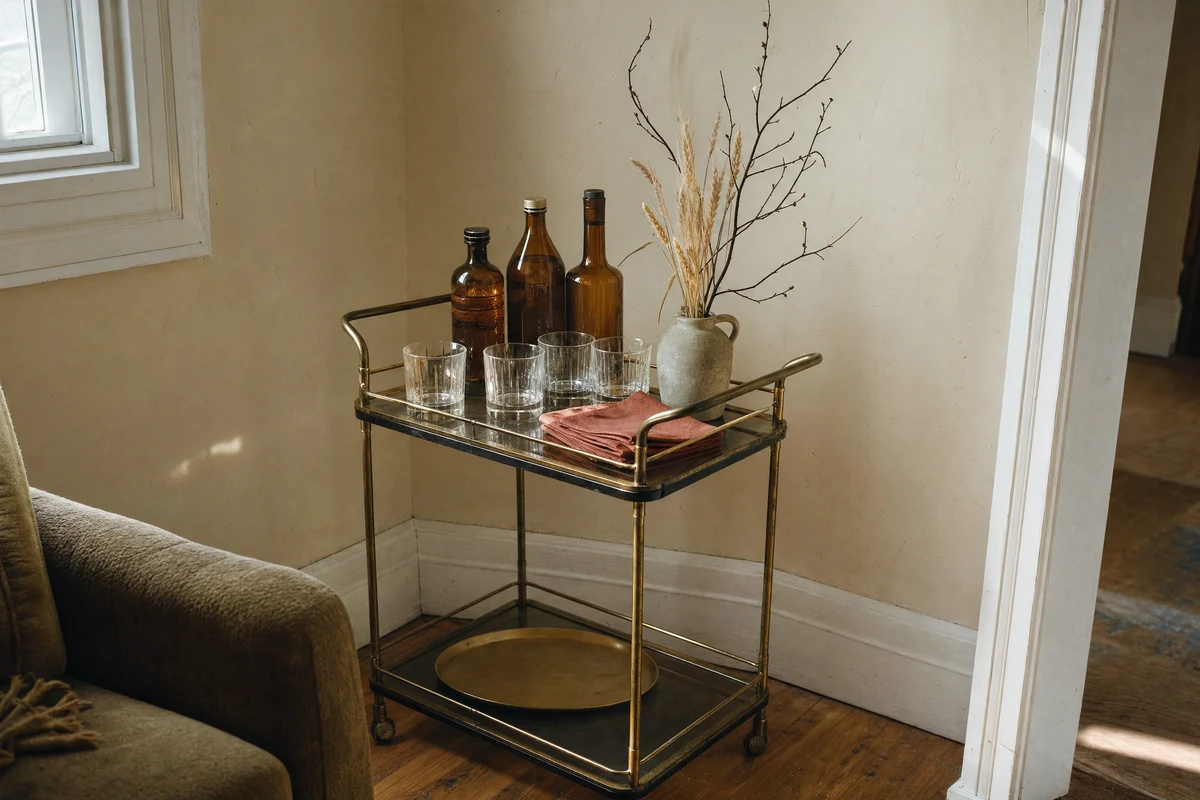
Dealer-marketplace listings for vintage brass carts start around $450 and run into five figures, but the cart most people end up with costs $60 to $250 on Marketplace or comes new from Target for about $120. Styling one for fall changes four items. The tray, the glassware and the good bottles stay where they were in June.
What a real one costs
On 1stDibs, vintage brass carts are listed from about $450 up past $19,000. Those are asking prices on a dealer platform rather than sold prices, so treat them as the ceiling of the market and not as a valuation of the thing in your dining room.
The middle tier is where you’ll actually shop: estate sales, Facebook Marketplace, Chairish, the furniture corner of a Goodwill. Budget $60 to $250 for something brass-toned with two glass shelves and casters that still roll. Prices run higher in cities with an established mid-century resale scene, which in practice means Palm Springs, Chicago and most of Southern California.
Then there’s the reproduction tier, which accounts for most of what gets pinned even when the caption says antique. Target’s Threshold metal-and-glass carts sit near $120. World Market’s wood-and-copper version is $199.99. Home Depot lists an oval gold one around $203.
The giveaway on a repro is the finish. New brass is lacquered and identical everywhere; old brass is uneven, darker in the crevices, and often worn through to a different color on the handle where hands went. The magnet check from the thrift sorting guide tells you the rest: solid brass won’t hold a magnet, plated steel will. Nearly everything under $200 is plated, old or new.
Telling an old cart from a new one
The maker names that move prices are worth knowing, though they split by country in a way the listings usually don’t explain. Aldo Tura, Cesare Lacca and Romeo Rega are Italian, and Tura is the one behind most of the lacquered goatskin and marquetry pieces. Maison Baguès and Maison Jansen are French, and Baguès is the brass-and-crystal end of the market. Milo Baughman is American, designing for Thayer Coggin in North Carolina, and his carts read plainer and more architectural than the Italian ones.
Don’t rely on finding a label. Italian carts of this era carried paper tags that are almost always long gone, so an unlabeled cart isn’t a fake and a labeled one isn’t automatically valuable. Judge it on construction: brazed joints rather than screwed brackets, glass that sits in a machined channel rather than on rubber pads, and casters with a solid brass housing instead of a plated cap over plastic. Flip it over. The underside of a sixty-year-old cart looks like sixty years.
What fall actually changes
Most seasonal bar cart advice restyles the whole thing, which turns a ten-minute job into a Saturday. Four changes carry it.
Swap the stems. Whatever green thing was up there in July comes off and something dried goes on: wheat, dried hydrangea, oak branches cut from your own yard for nothing. Grocery and craft-store bundles run $6 to $15 in September. Unlike fresh stems they’ll still look right at Thanksgiving, which is the argument for spending the $12 rather than reusing last year’s plastic ones. One caution if you’re buying bittersweet, which is the orange-berried vine in every fall arrangement: most of what’s sold is Oriental bittersweet, an invasive that several states have made it illegal to sell or transport. Connecticut has banned the sale since 2004 at $50 per plant in fines, and Minnesota prohibits sale and transport outright (it renamed the plant round leaf bittersweet in 2022, so that’s the label you’ll see there). American bittersweet is the native one, and it costs a little more.
Move the amber forward. You probably own something dark already. Bourbon, amaro, maple syrup in a decent bottle, Angostura. Fall on a cart is largely a color edit, and light through brown glass is why every October cart photo looks warm. Push the clear gin to the back.
Add one piece of cloth. Two or three linen cocktail napkins in rust, olive or oatmeal, or a small runner under the tray, under $15 at HomeGoods. A cart with no textile on it looks stocked rather than styled. If you’d rather skip the obvious palette, the no-orange approach transfers here without changes.
Fourth, and this one costs nothing: change the glass shape. Coupes look cold in October. Rocks glasses and small tumblers don’t, and four of a kind out front beats a mixed set of eight that don’t match each other.
Everything else stays. The tray, the ice bucket, the good bottles. A cart is a small surface, and treating every season as a full reset is how people end up not bothering by November.
The cart that doesn’t hold liquor
This is the version nobody stages, and a lot of people want it. Non-alcoholic beer, wine and spirits passed $1 billion in US off-premise sales in 2025 and grew 22% year over year according to NielsenIQ, with non-alcoholic spirits and canned mocktails up about 70% between 2024 and 2025.
It styles identically, and the bottles are frankly better looking. Seedlip and Ghia both sell in bottles designed to be left out; Athletic Brewing cans stack well in a low basket on the bottom shelf; Fever-Tree tonics and ginger beers give you the tall clear-glass element that a liquor cart gets from gin. Add a jar of cinnamon sticks, a small tray of citrus, and a bottle of something dark (cold brew concentrate, a spiced syrup, a shrub) and the cart does coffee service and drinks at once.
The practical difference is refrigeration. Syrups and shrubs need it once opened, so the good-looking bottle lives on the cart and the working bottle lives in the fridge.
What to skip
Skip the stack of cocktail books used as a prop. Two lying flat under a small vase is fine. Four stacked spine-out is a wall you’ll knock over reaching for the vermouth.
Also skip lacquer or metallic spray on an old brass cart. Patina is most of what you paid for, and refinishing takes a real chunk off resale. Plated repro carts, spray with abandon.
Load, wobble and the glass shelf problem
The common failure isn’t glass breaking under weight, it’s the shelf sliding in its frame when the cart rolls, because old shelves sit loose in a channel with nothing holding them. Clear silicone bumpers, about $5 for a sheet at any hardware store, under each shelf corner stop the slide and kill most of the rattle. Keep the heavy bottles on the bottom shelf.
Seized casters usually free up with a drop of light oil and ten minutes of working them back and forth. If you do need replacements, measure first. Vintage carts use grip-ring stems, threaded stems and plate mounts more or less at random, and stem diameter and length are what determine fit. Matching the brass finish is the harder problem, and it’s why most people oil the originals.
A wobble on the diagonal is the frame joints rather than the floor, and that’s a brazing repair. Any metal shop can do it. The quote usually lands somewhere north of what a $60 Marketplace cart is worth, which is worth knowing before you fall in love with one that racks.
Bar cart questions
How tall should a bar cart be? Most sit between 30 and 33 inches, which is a few inches below the 36-inch counter it’s probably standing next to. That’s normal and it’s why carts feel low when you pour.
What goes on the bottom shelf? Weight and backups: extra bottles, the ice bucket, a stack of napkins.
Can a bar cart work in a small apartment? Yes. It’s one of the few pieces that improves a tight room, since it rolls out of the way and doubles as coffee service or a landing spot for serving dishes when people come over. Narrow ones start around 24 inches wide, and 24 to 30 inches is the range that fits most apartment gaps.
Is it worth restoring a beat-up vintage cart? If the brass is plated and pitted, no. Re-plating costs more than the cart is worth. If it’s solid brass with tarnish, a $6 tin of Brasso and twenty minutes will do it.
Where do people find them cheapest? Estate sales on the final day, when prices drop by half and furniture is what’s left over.
If you’re building the look from a reproduction base rather than a real find, the same $20 upgrades in the cheap furniture guide apply here: better casters, and something with real weight on the top shelf.