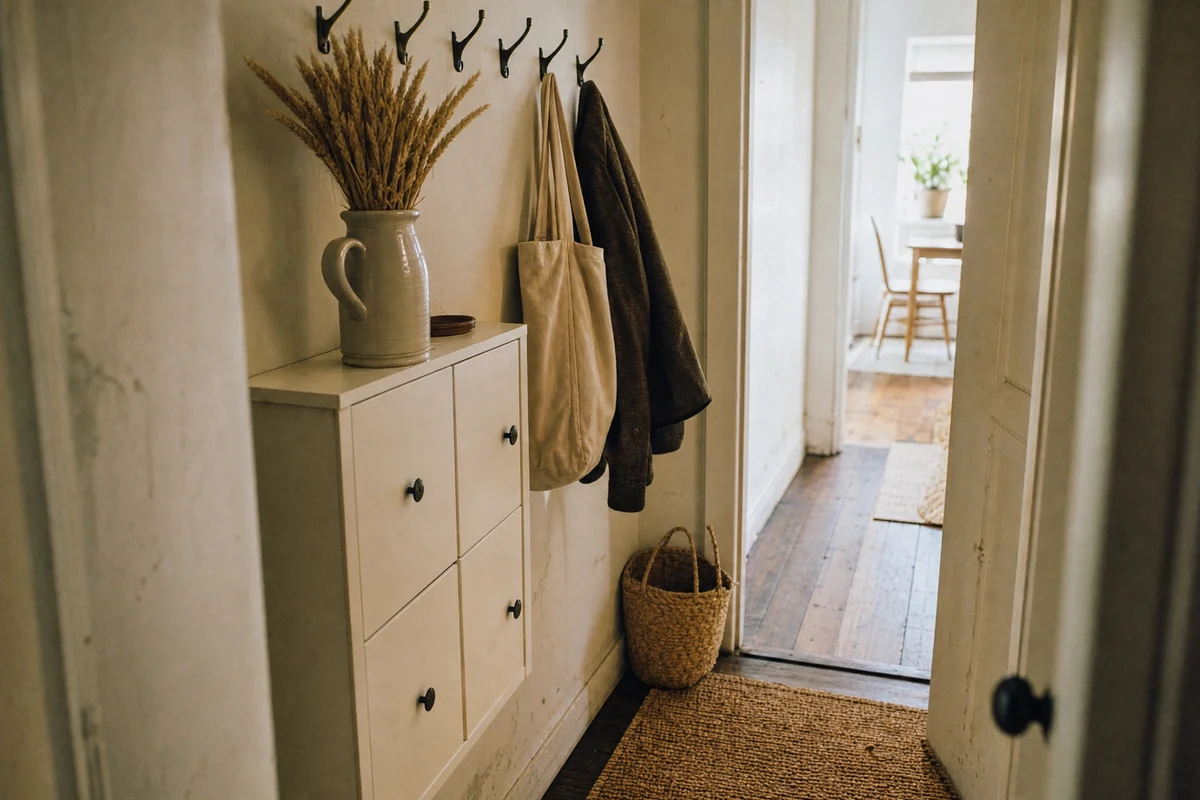
Measure the usable wall first, because that one number decides everything else. Under 30 inches you go vertical. Between 30 and 48 a narrow console fits. Past 48 you can add a bench. Then give keys, mail, bags, shoes and coats a place to land, and the fall styling takes about fifteen minutes on top of that.
Start with the wall, not the shopping list
Usable wall means the flat run between the door swing and whatever the entry opens into. Measure it before you buy furniture, and measure the walkway that would be left over. You want 30 to 36 inches of clear passage; below that people turn sideways to get past, which is the thing that makes a small entry feel worse than it is.
Depth matters more than width here. A standard console runs 12 to 18 inches deep. In a hallway you want 10 to 14, and those four inches decide whether people walk through the space or edge through it.
If your usable wall is under 30 inches, mount something shallow instead of standing furniture on the floor. IKEA’s TRONES is the default answer: 20½ inches wide, 15⅜ tall, 7⅛ inches deep, $39.99 for a two-pack, and IKEA rates each one at about four pairs of shoes. Two stacked puts a usable top surface at roughly 31 inches, near console height, with almost no floor lost.
The five things in your hands
Keys. Within arm’s reach of the door and above waist height, because a key bowl on a low surface means you’ll put them down somewhere else when your hands are full. A hook or small tray at about 45 inches does it. Cheapest fix here, and the one that changes the most mornings.
Mail. One container with hard sides rather than a flat tray, because paper spreads on a tray and stacks in a box. Pick one too small to hold three weeks of it, so it overflows early and you deal with it.
Bags. This is where renters get burned. A Command large hook is rated to 5 pounds, and the extra-large utility hooks go to 10 and 15. A work tote with a laptop in it lands around 10 pounds, and a wet wool coat is heavier than the same coat dry. Buy the 10 or 15 lb hooks. On difficult wall surfaces, the same adhesion tests from the peel-and-stick guide tell you whether anything will stick at all.
Shoes. Shoes decide whether the entry looks good, because they’re the mess visible from the next room. Two pairs stay out, the rest go into a closed cabinet or a lidded bin. If you have no closet, which is the usual case in the apartments this article is about, that bin is the whole system, and it should hold less than you own so the overflow forces a decision instead of a pile.
Coats. Hooks at 60 to 66 inches for adults, 36 to 48 for kids. Above a bench, leave 12 to 18 inches between the seat and the lowest hook or the coats drag on it. Benches want to be about 19 inches high and 15 to 18 deep.
That last number is the argument against a bench in a narrow entry. A 16-inch-deep bench in a 40-inch hall leaves you 24 inches of passage, which is under the 30 you need, so you get a seat you step around and never sit on. Under 36 inches of usable wall, skip it and put the money into hooks and a closed shoe cabinet.
The fall layer, and why it stays small
An entry is a passage, so everything seasonal has to sit above the traffic or behind it. Four things carry the season.
Dried stems in a jug on the shelf or console: wheat, dried hydrangea, or branches cut off your own tree. Craft and grocery bundles run $6 to $15 in September, and dried holds through Thanksgiving where fresh doesn’t.
Swap the mat. A jute or coir mat against the rubber-backed one you’ve had since spring is the single most visible change in the entry, roughly $25 at Target. Size up rather than down.
One textile, high or folded: a runner under the tray, or a throw over the bench in rust, camel or oatmeal. If the standard fall palette isn’t your thing, the no-orange approach works the same way in an entry.
A floor basket at the end of the run, which is storage that photographs as decor.
Three things to leave out: a wreath on the inside of the door, which bangs every time it closes; garland along the console, which sheds into whatever’s underneath it; and anything that needs a plug in a spot where the outlet is already doing work.
When the entry isn’t a wall
Plenty of entries are just the three feet where the door opens into the kitchen or living room. Build the drop zone onto the side of something already there: the end of a bookcase, the back of the sofa, the side of the fridge.
Adhesive hooks on a cabinet side, a magnetic strip on the fridge for keys, a slim basket tucked against a furniture leg. A bookcase’s outer edge takes hooks well, and its top shelf becomes the tray surface, so the bookshelf layering rules end up governing your entryway whether you planned that or not.
It looks less like a magazine entry. It also sits where you actually stop walking, which is the only reason drop zones work.
Light, if you have any
Some small entries have one overhead fixture. Many have none at all, just spill light from the next room, and that’s the harder case.
With a fixture: the overhead is almost always the least flattering light you own, and a 12-inch lamp on the console fixes more than any decorative purchase in this article. With an outlet but no surface, a plug-in wall sconce mounts with two screws and no electrician.
With neither, you’re on batteries, and the spec that matters is color temperature. Look for 2700K to 3000K on the box. The default for cheap LED pucks is 5000K, which is the blue-white of a parking garage and will undo the dried wheat entirely.
Entryway questions
How deep can a console be in a narrow hallway? Ten to 14 inches, and check what’s left for passage.
How high should coat hooks be? Sixty to 66 inches for adults. Above a bench, keep 12 to 18 inches of clearance so coats don’t sit on the seat.
What if I have no entryway at all? Build it on the side of the nearest furniture. Hooks on a bookcase edge plus a floor basket covers four of the five objects, and the fifth (mail) goes wherever you already open it.
Will Command hooks hold a winter coat? Not the 5 lb ones once the coat is wet. Use the 10 or 15 lb utility hooks, press for 30 seconds, and give the adhesive an hour before hanging anything.
Is a runner rug worth it in a small entry? Only if it’s machine washable. Entry textiles take grit and road salt, and one you can’t wash is filthy by February.
Start with the keys hook. Six dollars, four minutes, and it’s the one you’ll use twice a day for the rest of the year.